
Insights & Cases / Custom Content

ANONYMISED LEARNING DESIGN EXAMPLE

Technology risk.
Practise the next decision.

Connecting a familiar email situation with guided questions, risk-management responsibilities and knowledge checks.

Custom ContentBankingTechnology riskDesign example
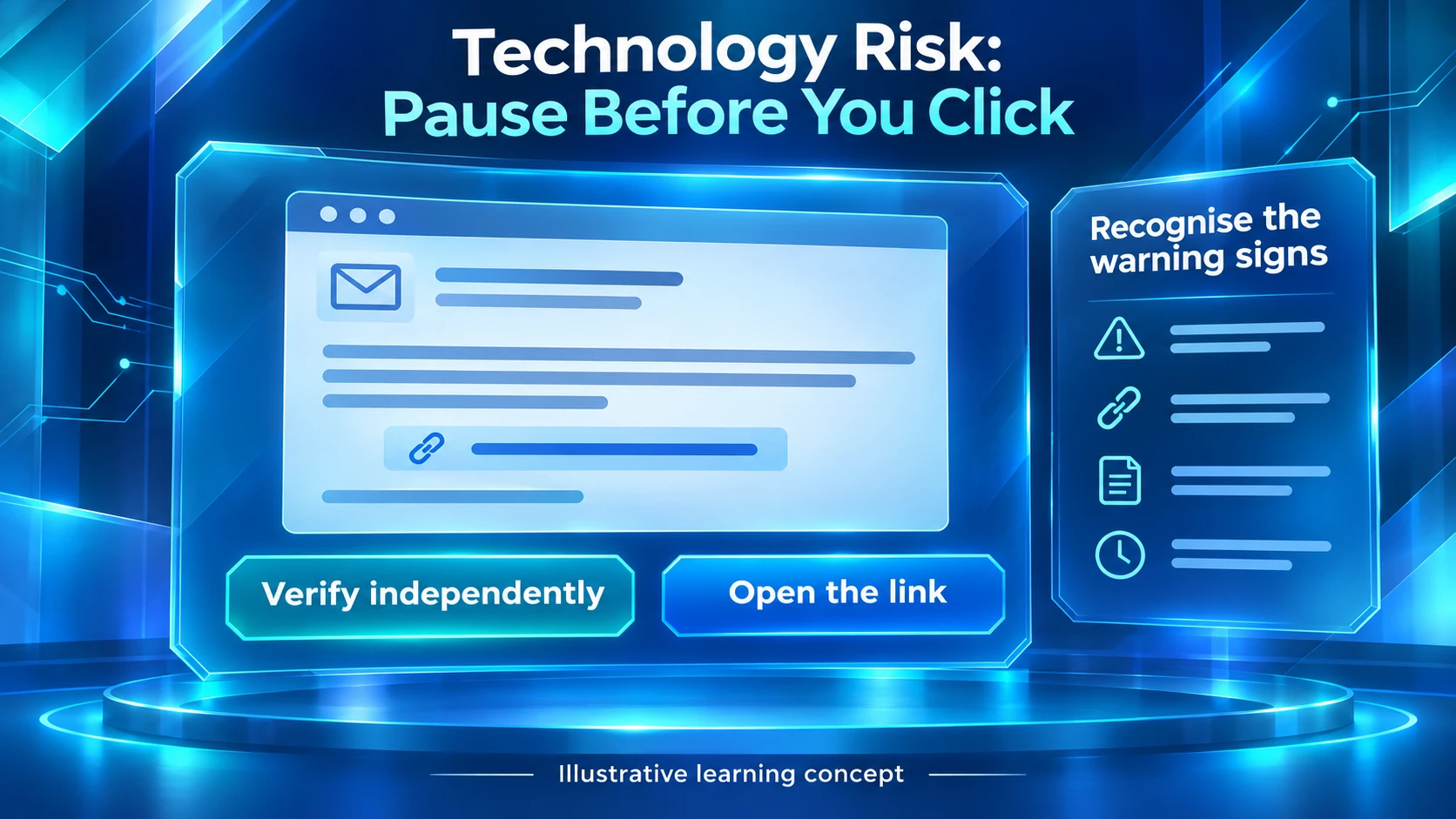
Fictional blue and cyan courseware decision screen about checking an email link.
AI-created illustrative learning concept. The wording, buttons and arrangement are newly created; this is not a client screenshot or a working course.
01 / THE LEARNING PROBLEM

Turn a policy topic into a decision.

Technology-risk policies describe responsibilities, but a learning brief also needs to identify the decisions employees face. An unexpected email provides a concrete starting point: what should the learner notice, and what should they do next?

02 / THE OBSERVED DESIGN

Context, prompts and explanation.

The historical course-design sample shows an email-link judgement activity, a visual explanation of technology-risk management responsibilities and a multiple-choice knowledge check. Its accompanying description outlines case-based choices, additional detail prompts and guiding questions.

03 / LANGUAGE SCOPE

Review meaning across languages.

The material lists Traditional Chinese, Simplified Chinese and English. This supports a multilingual design-scope description; it does not independently verify the completed delivery or acceptance of every version.

What this example demonstrates.

  • Scenario-based treatment of technology-risk awareness
  • Guided questions and detail prompts described in the design brief
  • Visual organisation of risk-management responsibilities
  • Decision activities and a multiple-choice knowledge check

The material does not establish learner completion, reduced security incidents, behaviour change or an LMS integration. It is historical design evidence, not current security-policy guidance.

Planning a new programme.

Start with approved source material and the decisions relevant to the audience. Agree who owns the correct response and how explanations should reflect current organisational procedures. Use fictional or approved scenarios and review every language version.

Specify assessment behaviour, accessibility, delivery format and any learning-record requirements separately. Review those requirements in the intended environment before launch.

Before commissioning.

What source material is needed?

Provide approved policies, audience roles, relevant situations, language requirements and a named subject owner who can resolve conflicting instructions.

Does a correct answer prove safer workplace behaviour?

A response shows performance on that activity under its stated conditions. Wider conclusions require additional evidence and a defined evaluation method.

Build a learning brief around the decisions your employees face.

Discuss your learning brief ↗

Related insight: beyond course completion ↗