ENTERPRISE CUSTOM CONTENT / CONTENT & SERVICES

Custom courseware.
Built for corporate training.

Turn policies, product presentations and instructor-led training materials into custom eLearning courses for employees across markets. Scope instructional design, interactive scenarios, assessments, SCORM delivery and agreed language versions around your training requirements.

BUSINESS NEED
Design→Practise→Apply
People ready for the work. ↗

COURSEWARE / SELECTED SCREENS

A closer look at custom learning.

Explore selected screens across compliance, information security, workplace safety, people development and technical learning. These are visual examples, not live course demos or a current course catalogue. Select an image for a closer look.

Bring your subject matter. We can discuss the right mix of explanation, visual design, practice and assessment for your audience.

Discuss your courseware programme ↗

Courseware example

MORE DESIGN IN PRACTICE

Fraud awareness.
Make the next step clearer.

Explore an anonymised learning-design example connecting illustrated scenarios, staff responsibilities, internal-reporting topics and judgement questions.

Explore fraud-awareness learning design ↗

DESIGN IN PRACTICE / COMPLIANCE

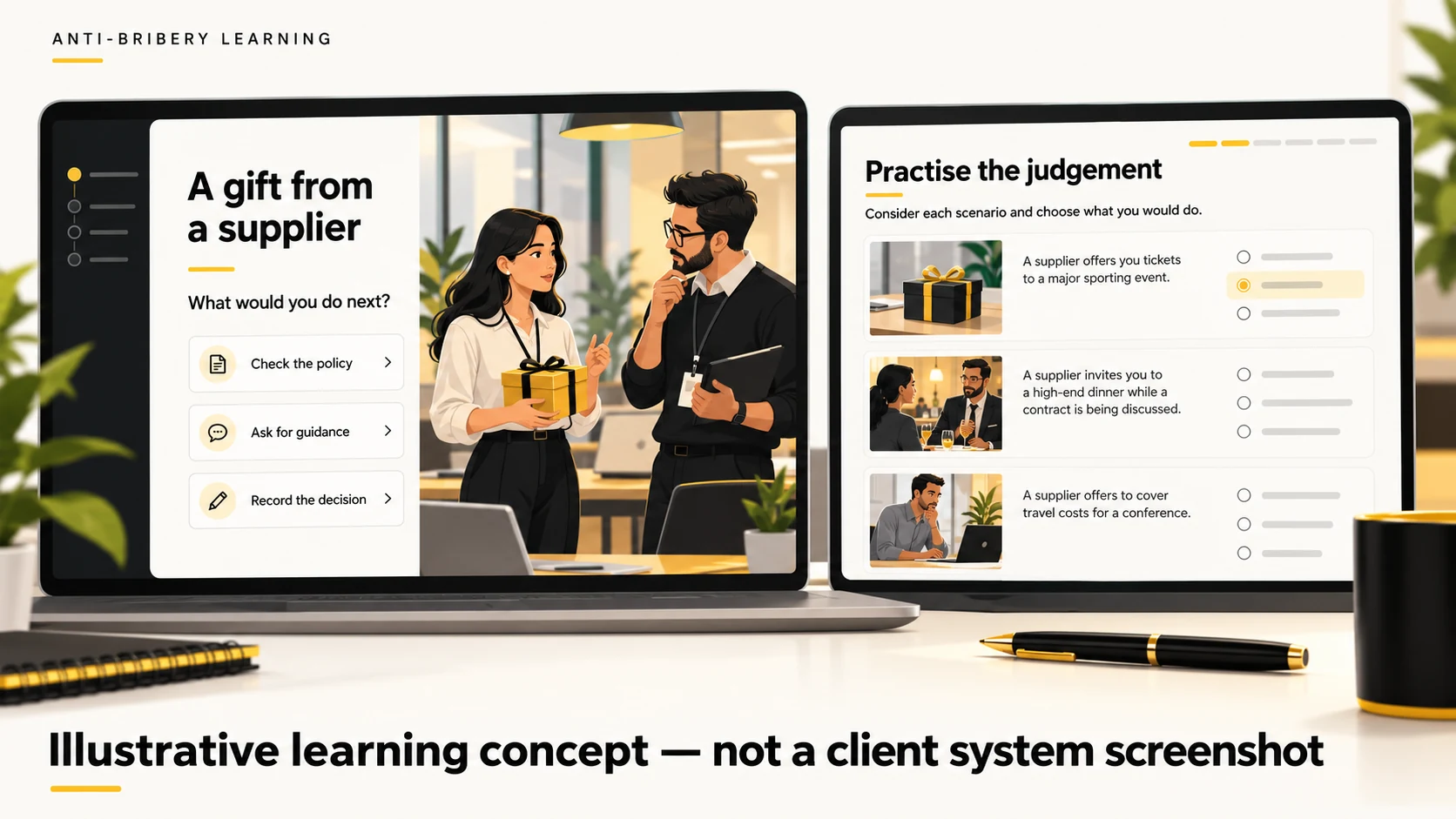
Anti-bribery learning.
Practise the judgement.

Explore how cases, visual explanation, interactive classification and assessment can structure a banking compliance course. This anonymised design example now has a dedicated place in our shared case library.

Explore the design example ↗
Illustrative anti-bribery learning concept; not a client screenshot.

FIND THE RIGHT STARTING POINT

Custom courseware development services.

Choose a service, then explore the work behind it. Several services can form one programme.

10 services

Select a card to explore the detail.
01DESIGN

Custom eLearning & bespoke courseware

Turn your policies, products and working knowledge into learning built around the decisions employees need to make.

Explore this service

Begin with the audience, the task and the performance gap. Agree the learning objectives, source ownership, storyboards and assessment before full production. Design modules that can be maintained when your products or procedures change.

  • Needs analysis and instructional design
  • Interactive scenarios, practice and assessment
  • Review milestones and a maintainable source structure
Discuss this requirement ↗
02DESIGN

Rapid eLearning development

Restructure existing presentations and subject-matter material into focused learning modules.

Explore this service

Rapid development works best when the source material is stable and the learning objective is clear. Decide which parts need explanation, which require a demonstration and where a learner should practise or answer a question. Plan content review alongside production.

  • Source-material review and restructuring
  • Reusable layouts and focused interactions
  • Agreed review and publishing workflow
Discuss this requirement ↗
03INTERACTIVE

Gamification & scenario learning

Use decisions, feedback and purposeful challenges to help people practise a business situation.

Explore this service

Start with the action a learner must take. Use branching choices, feedback or progression where they support that action. Agree scoring and feedback rules with the subject owner; completion and engagement measures should not be mistaken for proven workplace performance.

  • Decision-based scenarios and branching
  • Feedback tied to business judgement
  • Learning incentives with a clear purpose
Discuss this requirement ↗
04INTERACTIVE

Mobile learning & microlearning

Make focused learning available to employees working beyond the desk.

Explore this service

Break a wider programme into short activities with one clear objective. Check the access experience, reading load, media and assessment on the intended devices. Connect short modules to the wider learning pathway and reporting requirements.

  • Short modules and follow-up practice
  • Mobile-first reading and media choices
  • Connection to blended learning programmes
Discuss this requirement ↗
05PRODUCTION

Educational video & animation

Explain a process, demonstrate a task or introduce a subject through carefully planned visual learning.

Explore this service

Agree the message and storyboard before production. Choose animation, screen demonstration or filmed material around the learning need. Define narration, captions, language versions and the assets that should be retained for future updates.

  • Scriptwriting and visual storyboards
  • Animation and instructional demonstrations
  • Narration, captions and review planning
Discuss this requirement ↗
06PRODUCTION

Localisation & translation

Adapt a learning programme for the language and working context of its audience.

Explore this service

Translation is one part of localisation. Review terminology, examples, narration, screenshots and assessment wording with the relevant subject owners. Maintain a source version and a clear review process so changes can be carried through each agreed language version.

  • Terminology and contextual review
  • Cantonese, Mandarin and English production
  • Version control across agreed languages
Discuss this requirement ↗
07PRODUCTION

Legacy courseware conversion

Bring older learning assets into a format that employees can use and your team can maintain.

Explore this service

Audit the source files, media and learning requirements before choosing between republishing and rebuilding. Review obsolete interactions, links, accessibility and assessment tracking. Test representative content in the target learning environment before rollout.

  • Flash and older-content review
  • Rebuild or republish decisions
  • Desktop, mobile and tracking checks
Discuss this requirement ↗
08LIBRARY

Course library & content selection

Use existing learning content where the subject does not require a fully bespoke programme.

Explore this service

Map the requirement against available content before commissioning a new build. Check the audience, learning objective, language, rights, assessment and update responsibility. Where appropriate, combine library material with organisation-specific modules; availability and licensing are confirmed during scoping.

  • Content selection against the requirement
  • Library and bespoke combinations
  • Language, licensing and update review
Discuss this requirement ↗
09INTERACTIVE

Business simulation

Connect learning with guided practice in business and sales situations.

Explore this service

Use a simulation when a learner needs to practise choices and see their consequences. Define the business scenario, expected decisions, feedback and debrief. Discuss how MetaSim and supporting content fit the programme rather than assuming every requirement belongs in a standard module.

  • Business and sales scenarios
  • Practice, feedback and facilitated debrief
  • Connection to the wider learning pathway
Discuss this requirement ↗
10OPERATIONS

BPO & managed training administration

Support the recurring administration and operating work behind a learning programme.

Explore this service

Managed Learning sits within our broader BPO services. Define responsibility for enrolment, scheduling, learner support, content updates and reporting. Agree handoffs, service scope and escalation so administration connects with the platform and content rather than becoming a separate manual process.

  • Managed Training Administration
  • Learning-platform and content operations
  • Agreed responsibilities and reporting
Discuss this requirement ↗

MORE WAYS TO MAKE LEARNING WORK

Match the experience
to the business need.

A programme can combine several approaches. Cyberwisdom Group starts with the work people need to do, then connects content, practice, assessment and delivery.

01

Compliance, conduct & information security

Policy into decisions

Turn approved policies into situations employees recognise: financial crime awareness, data privacy, respectful behaviour and secure information handling. Add explanatory feedback and role-specific knowledge checks.

Explore custom learning ↗
02

Sales, product & employee onboarding

Knowledge into action

Organise product explanations and induction around the questions, conversations and tasks employees face. Connect a learning pathway with scenario practice, assessment and a clear next step.

Explore programme design ↗
03

Systems training & software simulation

Instructions into practice

Break a workflow into demonstrable steps. Use guided walkthroughs and safe practice where appropriate, followed by checks that reveal whether learners can follow the process.

Explore simulation ↗
04

Mobile learning & microlearning

A moment of need

Create focused explanations, short scenarios and refresher activities for the device and working context. Plan readable screens, touch-friendly interactions and a manageable learning sequence.

Explore mobile learning ↗
05

Legacy course conversion & rapid development

An existing asset, renewed

Review existing courses, presentations and source files. Choose video output, interaction redevelopment or a wider redesign according to the learning purpose, accessibility needs and available source material.

Explore content conversion ↗
06

Gamification, libraries & blended programmes

Participation with purpose

Use decisions, feedback and a purposeful progression to encourage practice. Where suitable, combine selected library material with bespoke content, workshops and LMS-managed assessment. Confirm availability and adaptation rights before selecting content.

Explore interactive learning ↗
01 / CONTENT

Explain and practise.

Use scenarios, visuals, demonstrations and focused learning activities.

02 / PLATFORM

Deliver and assess.

Connect learning pathways, online exams, mobile access and blended training.

03 / OPERATIONS

Coordinate and maintain.

Agree enrolment, reminders, version updates and reporting responsibilities.

START WITH A BUSINESS PROBLEM

Many topics.
One clear purpose for each.

These are example areas for programme scoping, not a list of ready-to-buy courses or client case studies. Content, assessment and delivery are shaped around your organisation.

Compliance & conduct

Help employees interpret a rule and choose an appropriate action.

Explore topic examples +
  • Policy understanding
  • Ethical decisions
  • Data protection awareness
  • Risk awareness
  • Workplace safety
  • Compliance refreshers
Explore a relevant service ↗

Customer, product & sales

Prepare people for conversations, products and service decisions.

Explore topic examples +
  • Product knowledge
  • Sales conversations
  • Customer service
  • Service recovery
  • Channel partner learning
  • Product launches
Explore a relevant service ↗

People & leadership

Build shared expectations and practise people-management situations.

Explore topic examples +
  • Employee onboarding
  • Manager development
  • Coaching conversations
  • Communication
  • Culture and values
  • Change readiness
Explore a relevant service ↗

Operations & systems

Connect instructions and system knowledge with the tasks people carry out.

Explore topic examples +
  • Process changes
  • SOP learning
  • System familiarisation
  • Quality awareness
  • Operational handovers
  • Digital working skills
Explore a relevant service ↗

FROM BRIEF TO CONTINUOUS USE

Design the whole journey.

The course, the platform and the operating process need to work together. Agree scope and acceptance criteria before delivery begins.

  1. 01

    Discover

    Define the audience, business task, source material and required evidence.

  2. 02

    Design

    Agree objectives, structure, scenarios and assessment before production.

  3. 03

    Build

    Produce the content, media and agreed language versions.

  4. 04

    Review

    Resolve subject-owner feedback and check representative learning journeys.

  5. 05

    Launch

    Check access, package behaviour and reporting in the target environment.

  6. 06

    Maintain

    Agree source ownership, version updates and ongoing operating responsibilities.

GO DEEPER BEFORE YOU COMMISSION

Programme planning & delivery detail.

Explore the full brief, capabilities and buying questions below.

Custom courseware programme overview
Home / Solutions / Custom Courseware
Custom courseware

Custom eLearning development and bespoke courseware

Bespoke courseware is where a learning strategy either becomes real or stays a document. Cyberwisdom Group's content team combines instructional design, project management, creative and graphic design and animation to build programmes that are structured for maintenance, published in standard open formats, and designed around the behaviour the business actually needs to change.

Who commissions the programme
Who this is for

The people who own this decision

Every business in this line is bought by someone different, and the evaluation criteria are different for each of them.

  • L&D leaders commissioning content

  • Marketing and product training teams

  • Learning technology owners managing content libraries

  • Compliance teams building regulated curriculum

Business problems to resolve
The business problem

What actually goes wrong today

These are the recurring failures we are brought in to fix. They are stated as business problems, because that is how they surface in your organisation — not as feature gaps.

01

Courses are built as one-off projects, so nothing is reusable and every change means a new project.

02

The brief is written in subject matter, not in behaviour, so the course covers the topic without changing what people do.

03

Content is produced in a tool nobody else can open, and the business ends up locked in.

04

Legacy courses stop working on modern devices and quietly become unusable.

Design, production and delivery capabilities
How we solve it

What Cyberwisdom Group actually provides

Capability without delivery is a brochure. These are the components we deploy, configure and run — and the boundaries of each.

  • Instructional design grounded in needs analysis — role, capability gap, and the performance the business needs.

  • Purposeful modality selection: self-paced e-learning, facilitated sessions, simulation, micro-learning and blended programmes.

  • Production across SCORM and xHTML-compliant formats so content stays portable and maintainable.

  • Legacy conversion — Flash and older courseware rebuilt or republished for modern desktop and mobile.

  • Localisation and translation, including Cantonese, Mandarin and English production.

  • Off-the-shelf library as a starting point: 1,000+ courses across compliance, IT, health and safety, sales and marketing.

Experience and content portfolio
What we can evidence
3,000+ e-learning courses delivered for corporations and government departments.
1,000+ off-the-shelf courses available, spanning compliance, information technology, health and safety, and sales and marketing.
20+ years of bespoke instructional design.
Industries and audiences
Buying questions and practical answers
Questions we are asked

Before you talk to us

The questions procurement, HR and compliance teams usually raise first. If yours is not here, ask it directly on WhatsApp.

When the behaviour you need to change is specific to your organisation, your product, your process or your regulatory context. If the requirement is a well-understood standard — a common compliance topic, for example — the library will serve you faster and at lower cost, and we will say so.

It depends on scope and the number of modules, and we would rather scope it properly than quote a number that will not hold. The plan covers needs analysis, design, build, review and deployment, with the review stage built into the schedule rather than bolted on at the end.

SCORM and xHTML-compliant packages, plus mobile-optimised delivery. The point of an open standard is that your content survives a platform decision three years from now, and stays maintainable in the meantime.

Yes. Most engagements are a mix: existing material converted or restructured, new modules built alongside it, and library content used to cover the parts that do not need to be unique.

CUSTOM ELEARNING FOR GLOBAL TEAMS

One course brief. Clear deliverables for each market.

A global custom eLearning project needs more than translated slides. Define the employee task, approved source content, language versions, review owners and target learning management system before production. Regional reviewers should check terminology, examples and assessment wording before each version is released.

PowerPoint and classroom training to interactive eLearning

Restructure presentations and facilitator notes into a course storyboard with explanations, practice questions and feedback. Use the rapid eLearning development service for stable source material; scope a deeper redesign where learners need branching scenarios or software practice.

SCORM courseware for your existing LMS

Specify the SCORM version supported by the target LMS, completion rules, pass score, resume behaviour and reporting fields. Include a representative package test in that LMS before accepting the full course library. Compatibility and tracking requirements belong in the project brief.

Multilingual course production and maintenance

Use a controlled master script and a terminology glossary. Review narration, captions, on-screen text and quiz answers together. Agree how a policy or product change will be applied to every maintained language version through eLearning localisation and translation.

Scenario-based compliance and product training

Commission situations employees actually encounter, with decision choices, feedback and an assessment linked to the training objective. Explore anonymised reputation-risk courseware, anti-bribery learning and custom courseware design examples.

What should a global custom eLearning brief include?

Provide the source files, employee roles, countries of use, required languages, course objectives, assessment rules, LMS specification and approval schedule. Identify who approves factual content and each language version. These inputs support a courseware scope and quotation with explicit deliverables.

Can existing courseware be updated instead of rebuilt?

Review the editable source files, media rights, interaction design and tracking requirements first. A policy-text change may require an update; obsolete interactions or missing source files may require a rebuild. Our legacy courseware conversion service starts with that review.

Next step

Plan your custom eLearning course.

Share your source presentation or policy, learner roles, required languages, target LMS and review deadline. We can scope the course structure, interaction level, assessment and delivery requirements.

  • What you are trying to evidence, and to whom
  • Which populations are in scope, and where they sit
  • What you run today, and what it does not give you
  • Your timeline, and any deadline you are working to