
CUSTOM CONTENT / LEARNING DESIGN
Privacy training: teach the decision, not just the rule.
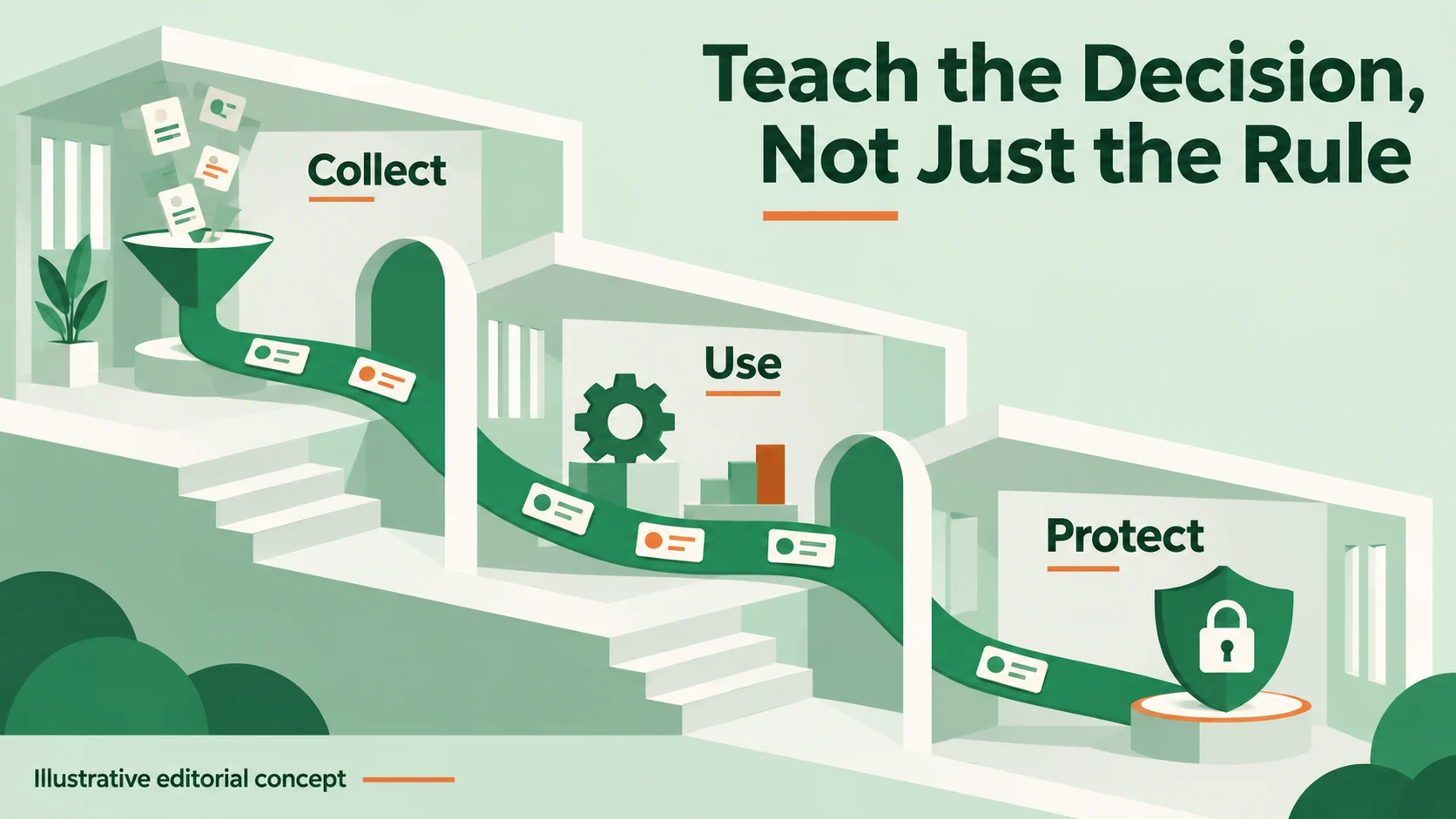
A privacy course can explain terminology while leaving the learner uncertain about a practical situation. A useful design question is: what should this audience notice, check or refer to an approved owner when a familiar request changes?
This guide proposes a course-design approach. It does not interpret privacy legislation or prescribe a universal organisational procedure.
Start with an ordinary situation.
Identify an activity the audience recognises: responding to a request, using an existing list or handling information during a service conversation. Ask the subject owner which details matter and which approved sources govern the action.
Use fictional information in practice activities unless another treatment has been explicitly approved. A convincing learning situation does not require real customer records or identifiable people.
Define what the learner must decide.
A question needs a clear purpose. Decide whether it tests recognition of missing information, selection of an approved next step or identification of the right person to consult. Provide enough context for the answer to be defensible.
For example, a fictional exercise can introduce a proposed use of information whose approval is unclear. The learning objective can be to recognise the need to check that purpose and consult the designated owner. The organisation’s own current rules determine the applicable process.
Make feedback explain the judgement.
Feedback should connect the situation to the approved rationale. Explain what the learner needed to check and why a response fits the stated conditions. Avoid suggesting that a short exercise covers every circumstance.
Give the learner a way to review the situation after an unsuitable answer. Keep the explanation understandable without turning it into a copy of the policy document.
Assign review and update ownership.
Agree who owns source accuracy, learning acceptance and future revisions. For multilingual courses, check that the same decision and rationale survive across language versions. Review examples when the underlying process changes.
If the course is delivered through an LMS, define the completion and assessment records required, then test the actual package and reporting behaviour. A completion status describes a learning event; wider compliance or behaviour claims require separate evidence.
Review one activity before scaling.
Take one draft scenario to its subject owner and a representative learner. Ask whether the situation is clear, whether the response is justified and whether the explanation points to an approved next step. Resolve disagreement before producing a large question bank.
View the related privacy-learning example, image and 10-second course simulation ↗