01 / BUSINESS QUESTIONWhat should an employee notice?
Reputation risk can feel remote from an ordinary working day. A learning brief becomes more concrete when it identifies the situations employees may encounter, the decisions they need to recognise and the approved responsibilities that guide their next step.
02 / OBSERVED DESIGNMake the response a learning activity.
The supplied banking course-design sample describes using cases to guide judgement and applying knowledge through a concluding test. Selected screens show a workplace dialogue with response choices, a matching activity, learning-resource and test entry points, and a multiple-choice assessment question.
03 / LANGUAGE & PRESENTATIONKeep the learning journey recognisable.
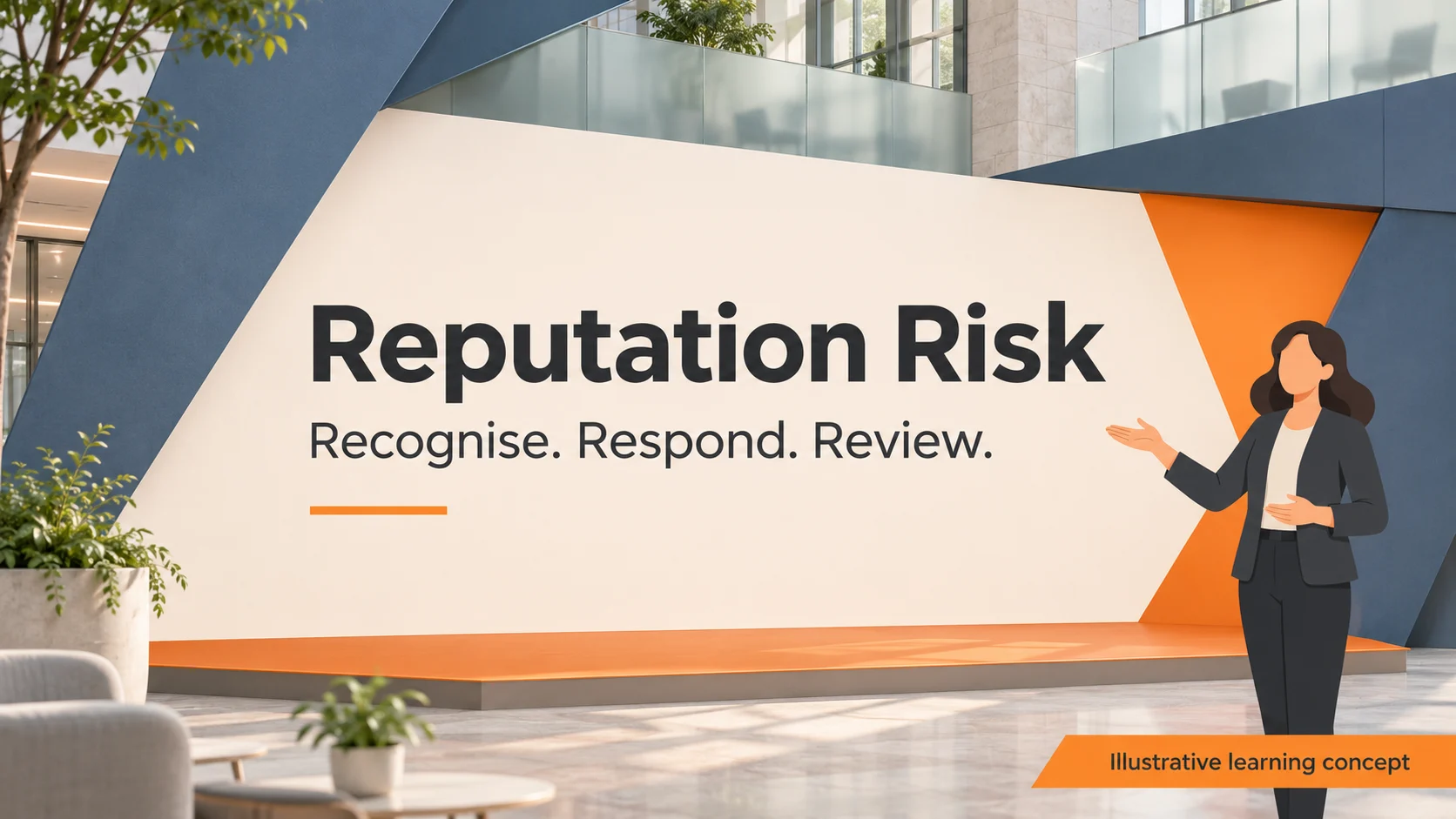
The material lists Traditional Chinese, Simplified Chinese and English. Its orange and slate-blue angular framing, office setting and illustrated presenter give the subject a coherent course identity. The new visual above adapts that language with fictional content and a different composition.
What the material demonstrates.
- Case-led treatment of a reputation-risk learning topic
- Workplace dialogue and judgement-response choices
- A matching activity that asks learners to distinguish information
- Learning-resource and assessment entry points
- A stated three-language course scope
This historical design sample does not establish learner completion, fewer incidents, improved reputation or a particular LMS integration. The newly created image is illustrative, rather than evidence of project results.
Plan a new reputation-risk programme.
Begin with approved source material and the roles of the intended audience. Identify the situations they need to recognise, the information available at each decision and who owns the relevant response or escalation instructions.
Connect scenarios, explanations and questions to defined learning objectives. A matching exercise can be scoped to help learners distinguish concepts; a judgement activity can test whether the next step is supported by the context. Have subject owners review the complete question and feedback together.
Questions before commissioning.
How do we choose suitable situations?
Choose situations relevant to the audience and confirm their learning purpose with the subject owner. Use fictional details or specifically approved source material and avoid unnecessary personal or customer information.
Can the course include our response process?
Yes, the course brief can be scoped around an approved organisational process. Confirm the responsible roles, information requirements, decision boundaries and review ownership before production.
What evidence should an assessment provide?
Define what each activity is intended to test and which records are required. An answer or completion record should be described according to what it captures; wider behaviour and business outcomes require separate evidence.